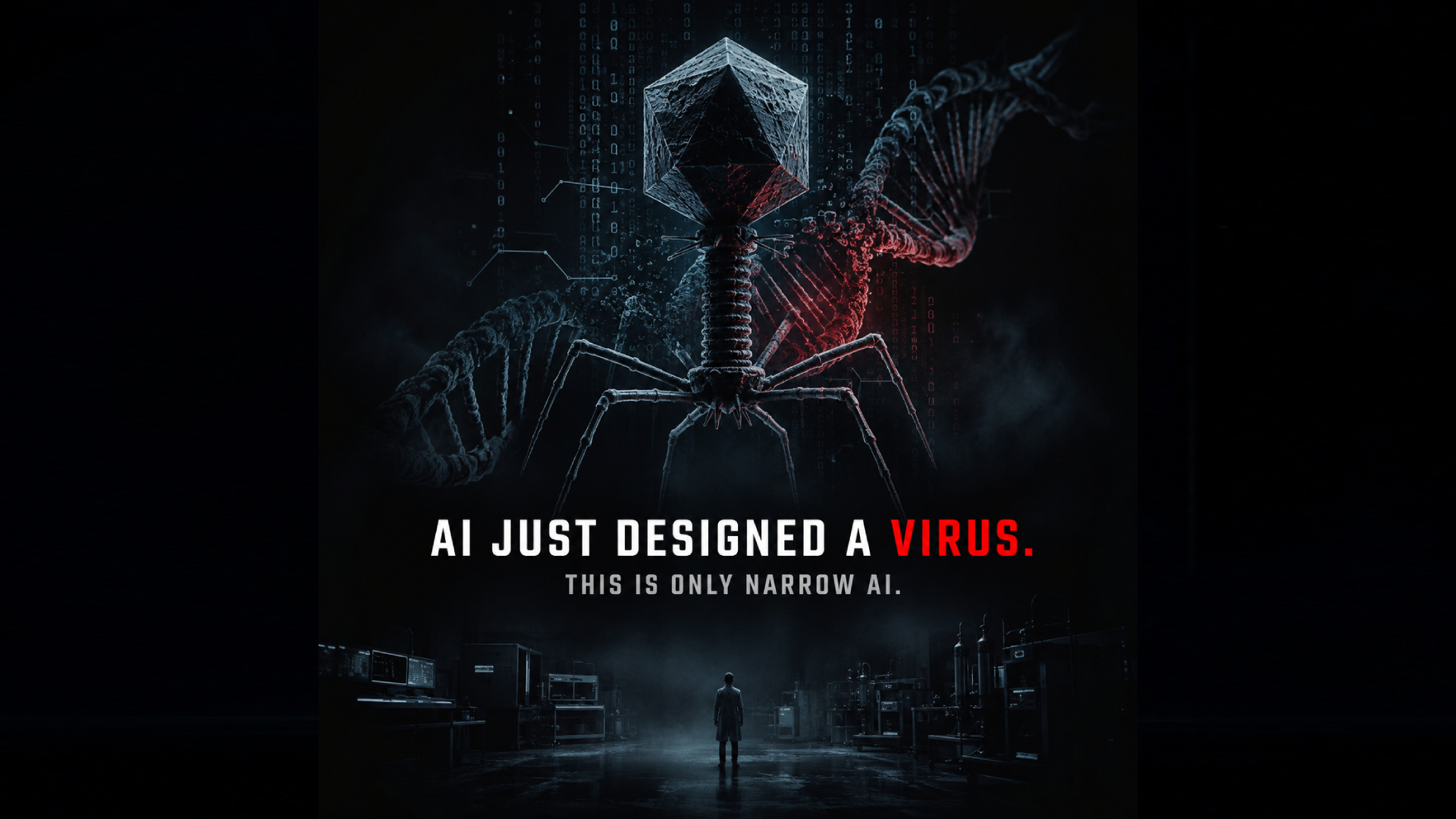
Artificial intelligence has crossed another boundary.
Scientists at Stanford University and the Arc Institute used genomic AI models to design complete viral genomes. Researchers selected and synthesized approximately 300 AI-generated designs—and 16 became functional viruses capable of infecting and killing E. coli bacteria.
Before anyone panics, these were bacteriophages: viruses that attack bacteria, not humans. This breakthrough could eventually help doctors fight antibiotic-resistant infections and dangerous superbugs.
But that isn’t the part that should keep us awake at night.
The experiment demonstrated that AI can now generate the genetic instructions for a functioning virus that never previously existed in nature.
AI didn’t merely analyze a virus.
It helped design one.
Today, researchers still require advanced laboratories, DNA-synthesis equipment, biological expertise and extensive physical testing. Only a small percentage of the AI-generated designs worked.
But AI is improving rapidly.
What happens when future models become more accurate? What happens when this technology becomes cheaper and more accessible? And what happens if someone trains a powerful genomic AI on pathogens that infect humans, animals or crops?
A malicious person might eventually use AI to explore biological designs faster than governments could detect them. A novel pathogen could potentially be difficult to recognize and might not respond to existing medicines or vaccines.
This doesn’t mean an AI-created pandemic is happening today. These bacteriophages were deliberately created to attack bacteria, and they may ultimately save lives.
But the breakthrough reveals a serious AI biosecurity risk that governments cannot afford to ignore.
We urgently need:
• Mandatory screening of synthetic DNA orders
• Restricted access to dangerous genomic AI capabilities
• Stronger security inside biological laboratories
• International rules for AI-designed pathogens
• Independent testing and oversight of powerful AI models
And here is the most unsettling detail:
This was achieved using Narrow AI.
We have not yet reached Artificial General Intelligence. We are nowhere near confirmed Artificial Superintelligence.
If today’s specialized AI can already help create functioning biological systems, what could AGI design—and would humans remain capable of controlling it?
The question is no longer whether AI can affect the physical world.
The question is whether our safety systems can evolve before AI’s capabilities move beyond them.
🎥 BBC News report:
https://youtu.be/z9FXO6_0Nv0
#ArtificialIntelligence #AIVirus #AIDesignedVirus #Biosecurity #Bacteriophage #SyntheticBiology #AGI #Superintelligence #AISafety #FutureTechnology #BBCNews